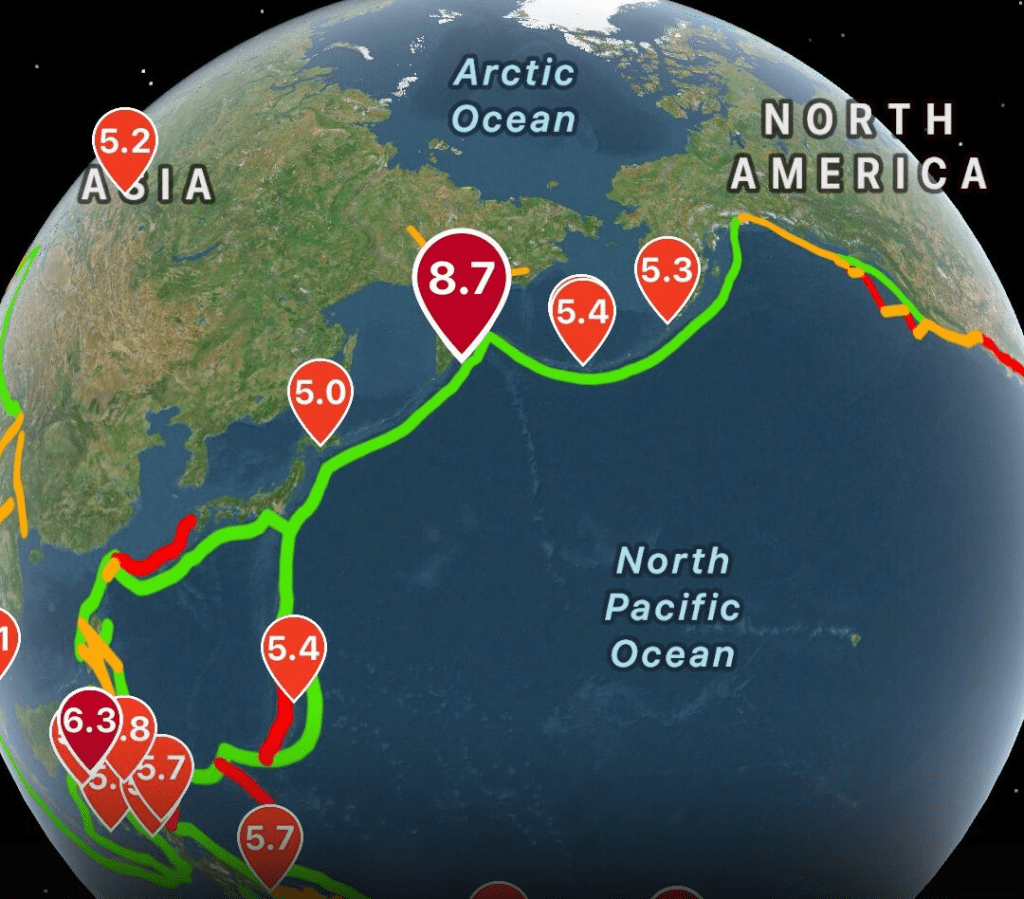
A strange situation has drawn attention in recent hours off the coast of Japan , specifically in the city of Tateyama , located in Chiba Prefecture , south of Tokyo. According to local media, several whales were found near the shore in a rare event that occurred just hours after the powerful 8.8 magnitude earthquake recorded off the coast of eastern Russia .

The unusual sighting was reported by local residents, who alerted authorities after observing the presence of these marine mammals so close to land. The images quickly began circulating on social media and news platforms, generating a wave of speculation about a possible connection between the seismic movement and the animals’ behavior.
Marine life and geophysics experts have explained that while there is no proven direct cause-and-effect relationship between earthquakes and whale strandings, there are reports that certain natural phenomena can alter their orientation or navigation patterns. Sudden changes in the Earth’s magnetic field , alterations in ocean currents , or even the modification of routes by underwater seismic waves could be among the possible causes.
The 8.8 magnitude earthquake , which struck the Kamchatka region , triggered tsunami warnings in various parts of the Pacific , including Japan. Japanese authorities issued warnings of possible sea level rise, especially in areas such as Hokkaido , Chiba , and other coastal zones. While the tsunami’s impact was moderate in Japan—with waves recorded at less than one meter—strict precautionary measures remained in place throughout the country.
The appearance of whales off the coast of Tateyama was surprising not only because of its proximity to the seismic event, but also because of the number of whales sighted in one place. Although some media outlets have attempted to link it directly to the earthquake, scientists insist on the need for further analysis before drawing definitive conclusions. Similar events have occurred in the past without prior seismic activity.
Environmental organizations in Japan have urged people not to interfere with the animals and allow specialized teams to handle the situation. They have also urged the public to remain calm and not spread unverified information, especially on social media, to avoid unnecessary confusion or panic.
For the time being, authorities continue to monitor both the state of the sea and the behavior of marine species in the area. Seismic surveillance has also been strengthened in the country, due to the possibility that the strong earthquake in Russia could generate aftershocks or influence other geological faults in the Pacific region .
It’s worth remembering that Japan is one of the most seismically active regions in the world and has an advanced natural disaster detection and response system . This new phenomenon, with whales near the coast after a major earthquake, reopens the debate about the connection between nature and the Earth’s major movements. For many, beyond a coincidence, these types of events invite reflection on the delicate balance of ecosystems and the way living beings react to changes on the planet.
@unitel.bo Varias ballenas aparecen varadas en la costa de Tateyama, prefectura de Chiba, Japón, tras el megaterremoto de 8.8 en Rusia #Rusia #Japón #Sismo #Terremoto #UnitelDigital ♬ sonido original – UNITEL BOLIVIA