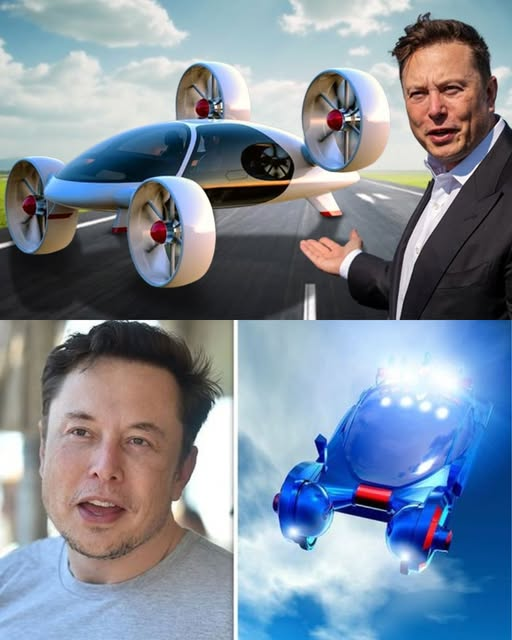
In a groundbreaking announcement that has sent waves across the automotive and aerospace industries, Elon Musk has officially confirmed that Tesla’s much-anticipated flying car will take off before the year 2027. This revelation marks a pivotal moment in the history of transportation and reaffirms Musk’s reputation as one of the world’s boldest innovators. With an eye toward revolutionizing urban mobility, reducing congestion, and embracing sustainability, Tesla’s flying car project is set to redefine how humanity moves through the world.
The concept of flying cars has long been the stuff of science fiction, but Tesla is turning fantasy into reality. According to Musk, the prototype of Tesla’s flying vehicle has already entered advanced development stages, and the final model is expected to be unveiled within the next two years. Designed with cutting-edge technology, artificial intelligence integration, and sustainable electric power, the flying car is poised to become a symbol of the future.
What Does Tesla’s Flying Car Look Like?
Tesla’s flying car, unofficially dubbed the “Model F,” showcases a sleek and aerodynamic design that blends elegance with functionality. Early renderings and insider descriptions reveal a futuristic vehicle that resembles a hybrid between a luxury sports car and a compact aircraft. The vehicle features a lightweight carbon-fiber body, retractable wings, and vertical takeoff and landing (VTOL) capabilities, allowing it to operate in both urban and rural environments.
Inside, the Model F boasts Tesla’s signature minimalist interior, complete with advanced autonomous navigation systems, a panoramic windshield, and next-generation infotainment powered by Tesla’s proprietary software. Comfort and safety remain top priorities, with anti-collision AI, emergency landing protocols, and biometric access control included as standard features.
The Technology Behind Tesla’s Airborne Innovation
At the heart of Tesla’s flying car is a powerful electric propulsion system that leverages multiple vertical lift rotors and a central thrust engine. Unlike traditional aircraft, the Model F uses battery-powered motors that eliminate the need for fossil fuels, making it an eco-friendly alternative to helicopters and planes. Tesla’s advanced battery technology, which has already revolutionized the EV market, will play a critical role in enabling extended flight time and short recharging intervals.
Moreover, the flying car will integrate with Tesla’s full self-driving (FSD) suite, offering a semi-autonomous flight experience. Passengers will be able to input their destination, sit back, and allow the onboard AI to handle takeoff, navigation, and landing with precision. This hands-free travel experience aims to reduce pilot error and improve safety for both passengers and those on the ground.
Impact on the Future of Transportation
With the launch of Tesla’s flying car projected before 2027, a new chapter in human transportation is about to begin. Urban congestion, long commute times, and limited mobility options could soon become relics of the past. Flying cars offer a promising solution to the growing challenges of overpopulated cities and overburdened infrastructure. By taking advantage of vertical space, Tesla plans to open up the skies for personal and public transportation.
Musk envisions a world where flying vehicles operate on smart air routes, coordinated by AI-driven air traffic systems. This innovation will not only increase efficiency but also unlock new opportunities in logistics, emergency response, tourism, and beyond. As cities adapt and invest in aerial infrastructure such as skyports and charging hubs, Tesla is expected to play a leading role in shaping these futuristic ecosystems.
Challenges and What Lies Ahead
Despite the excitement, the road—or rather, the sky—to mainstream adoption will not be without challenges. Regulatory approval, air traffic integration, safety certifications, and public acceptance remain key hurdles. However, Tesla has a proven track record of overcoming industry skepticism, as seen with the rise of electric vehicles and autonomous driving.
Industry analysts predict that early versions of Tesla’s flying car may initially be limited to private use, elite consumers, or commercial operators. Over time, costs are expected to decrease, leading to broader adoption. Musk has hinted at potential collaborations with governments and private entities to accelerate infrastructure development and regulatory alignment.
Conclusion
Elon Musk’s announcement of a Tesla flying car ready for takeoff before 2027 signals a bold leap into the future. With visionary design, revolutionary technology, and a commitment to sustainability, Tesla is once again pushing the boundaries of what’s possible. While challenges lie ahead, the excitement surrounding this innovation is palpable. As the world eagerly awaits the official launch, one thing is certain—the age of flying cars is no longer just a dream. It’s happening, and Tesla is leading the way.