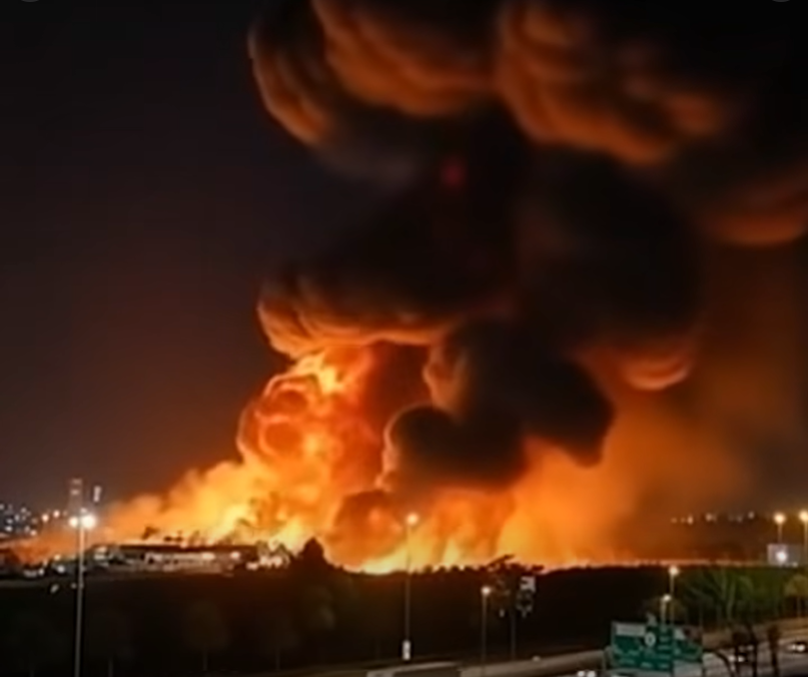
Industrial safety and disaster management protocols are of paramount importance within urbanized zones, especially when large-scale chemical or storage facilities are located in close proximity to major transportation corridors. The catastrophic implications of an uncontained industrial explosion become instantly clear when massive plumes of thick black smoke and intense fire ball eruptions consume a commercial complex during the night. Emergency management teams, municipal fire departments, and hazardous material specialists face immense operational challenges when tasked with suppressing highly volatile, fuel-backed blazes that light up the night sky for miles around. When a major industrial facility suffers a continuous series of high-energy explosions, the convective force generates towering clouds of soot and ash that can rapidly impact air quality and public health across an entire metropolitan region. Such large-scale industrial disasters serve as a stark, dramatic reminder to urban planners and regulatory agencies regarding the critical necessity of strict zoning laws, continuous facility inspections, and robust automated suppression systems.
The psychological impact on nearby citizens and commuting motorists witnessing an apocalyptic industrial fire is profound, often inducing widespread public anxiety and immediate travel disruptions along surrounding highway networks. Modern municipal infrastructure relies heavily on pre-planned evacuation routes, emergency broadcast alerts, and coordinated traffic diversion strategies to protect the general public from potential toxic gas exposure or secondary blast waves. Despite rigorous safety standards across modern manufacturing sectors, the potential for mechanical failure, electrical malfunctions, or human error underscores the persistent risks inherent in large-scale energy and chemical processing. Fire codes and industrial safety regulations must be continuously updated and strictly enforced by government authorities to mitigate structural losses, prevent extensive environmental damage, and above all, safeguard human life. Investigating forensic teams and safety experts must meticulously analyze structural debris patterns, facility maintenance logs, and thermal telemetry data to accurately pinpoint the structural origin of a massive industrial breach.
Public safety campaigns consistently highlight the critical importance of early warning systems, regular employee safety drills, and the immediate notification of emergency services during the initial stages of a facility fire. The wider financial fallout of an industrial complex fire extends far beyond immediate property damages, encompassing prolonged business supply chain disruptions, extensive environmental remediation costs, and long-term insurance liabilities. Industrial operators invest heavily in developing complex multi-layered risk mitigation strategies, including fail-safe automated valves, flame-retardant barriers, and specialized on-site fire response infrastructure designed to contain emergencies early. When multiple fire engines and emergency vehicles converge on a major industrial crisis zone, it triggers a highly tactical operation where commanders must carefully balance active fire suppression against the physical safety of their personnel.
The shocking visual contrast between a peaceful urban highway at night and a raging, uncontrollable industrial inferno nearby underscores the unpredictable nature of industrial operations within modern society. Motorists traveling along adjacent arterial roads often experience a collective sense of vulnerability as they witness firsthand the immense, destructive energy of a runaway chemical or industrial fire event. Comprehensive technical training programs for industrial plant managers remain a top national priority to ensure that operating personnel possess the requisite skills to execute emergency shutdowns smoothly during a critical system failure. Maintaining a heightened state of regulatory vigilance and investing in modern, resilient infrastructure are foundational pillars for minimizing the societal impact of large-scale commercial or industrial accidents.
As technological integration advances within the manufacturing sector, the deployment of real-time environmental sensors and remote drone monitoring systems becomes increasingly vital for detecting early anomalies before they escalate into full-scale disasters. Every major incident that is successfully contained without spreading to broader civilian residential zones highlights the critical value of seamless coordination between private facility operators and public emergency services. The efficient stabilization of a highly dangerous industrial scene allows surrounding transit infrastructure to reopen quickly, thereby restoring the necessary flow of daily economic activity and public transportation. Ultimately, ensuring long-term safety within highly industrialized modern societies requires an unwavering, proactive commitment to technological innovation, rigorous regulatory oversight, and deep corporate accountability. By closely studying these catastrophic industrial events, communities can better implement advanced safety designs, strengthen emergency readiness, and ensure the ongoing protection of human life and urban environments.